Empire of Light (2022): A Cinematic Projection of Why Community and Connections Matter

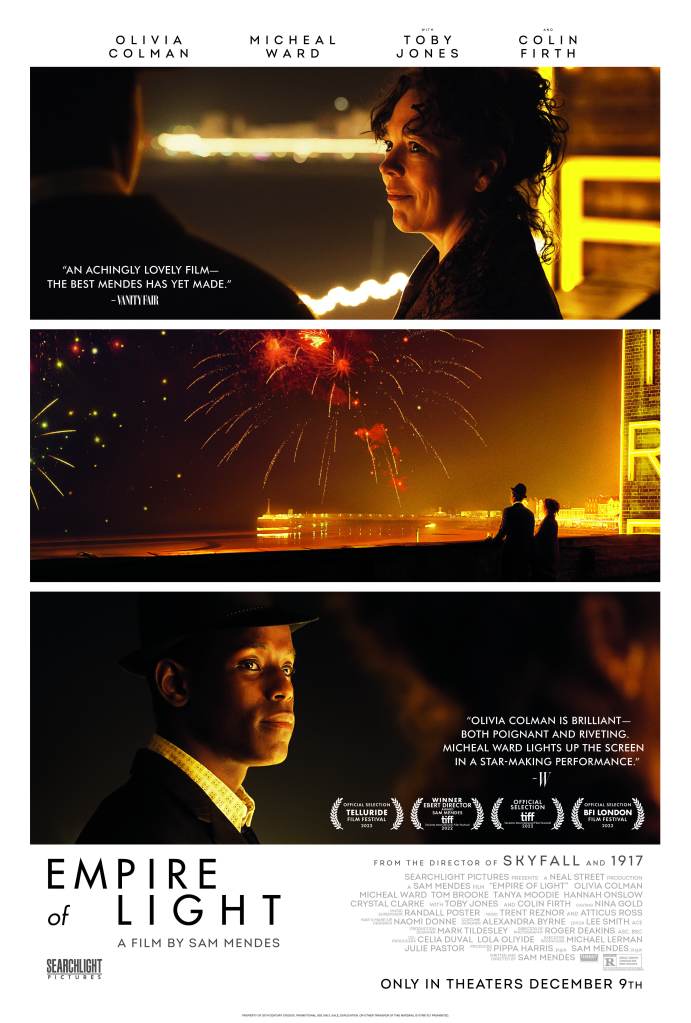
“Empire of Light” is directed by Sam Mendes (1917, Spectre) and stars Olivia Colman (The Favourite, The Crown), Michael Ward (The A List, The Old Guard), Monica Dolan (A Very English Scandal, Appropriate Adult), Tom Brooke (Preacher, Game of Thrones), Tanya Moodie (Star Wars: The Rise of Skywalker, A Discovery of Witches), Hannah Onslow (This Is Going to Hurt, Ridley Road), Crystal Clarke (Sanditon, Ordeal by Innocence), Toby Jones (Harry Potter and the Chamber of Secrets, The Hunger Games), and Colin Firth (1917, Kingsman: The Secret Service). This film is about a group of people living in 1980s England who work together at a cinema. Two of these people, specifically Hilary, the manager, and Stephen, a recent hire, develop a bond and take their connection to the point of a committed relationship.

There is a saying that Hollywood loves itself. Movies like “La La Land” and “Once Upon a Time in Hollywood” highlight such a point. But while those movies are their calendar year’s shining example of “movie about movies” storytelling, 2022 is not short on these kinds of stories. “The Fabelmans,” which is based on Steven Spielberg’s youth, highlights the power of making movies. “Clerks III” doubles as a homage to Kevin Smith’s previous creations while also paying tribute to people want to create a film. I think it also shows how difficult such a process can be, both in front of and behind the camera. “The Unbearable Weight of Massive Talent,” which stars Nicholas Cage as himself, pays tribute to various movies he made (and some he did not) while also poking fun at the way certain cinematic stories are told. “See How They Run” features a storyline where people want to turn a play into a motion picture. Later this month, “Babylon,” which is set in old Hollywood, will hit theatres. Some may call it self-indulgent, self-absorbed, or self-obsessed. Based on how I liked all these movies, minus “Babylon,” which I have yet to see, I would call it “writing what you know.” One thing is for sure, Hollywood knows movies.

While “Empire of Light” does not entirely highlight people making movies, it does highlight another important aspect of the filmmaking process, selling the movies. Most of this film takes place at a movie theatre. Not a modern day multiplex like AMC or Regal, but a small venue with a couple screens. The building itself looked beautiful. Similar to how “The Fabelmans” emits a certain magical feeling in regard to filmmaking itself, the cinema here emits an alike feeling to the point where just being inside it feels like an escape from your problems.

Despite being in a digital age where everything is at our fingertips, I am glad we still have movie theaters. In fact, I had the chance to watch “Empire of Light” at the Coolidge Corner Theatre, which if you are not from the Boston area, is a cinema in Brookline, Massachusetts that has some killer Art Deco vibes and a lot of history. It is a great place to see a movie. Watching a movie like this in a theater of that nature, the kind where they open and close the curtains before and after the movie, felt beautifully trippy. The best movies are those that take you to another world, and despite being in an older movie auditorium, I felt like I escaped into another auditorium somewhere else.

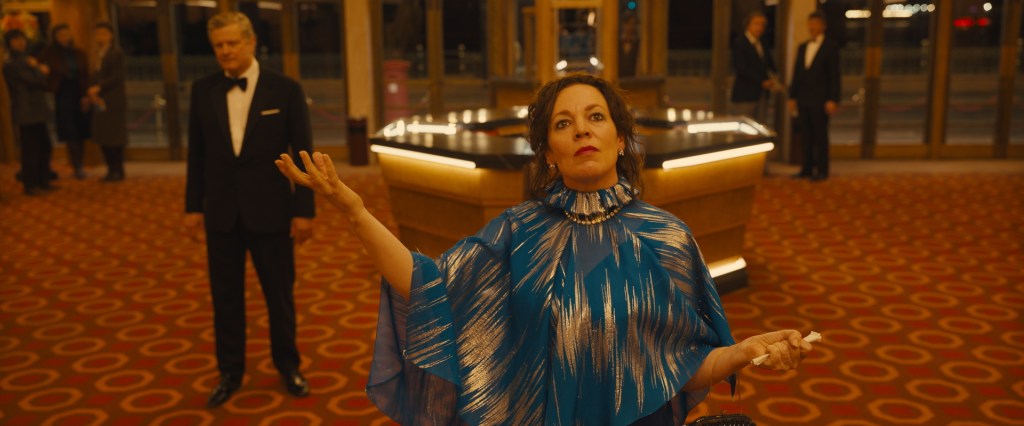
Joined by other casting standouts like Michael Ward, Toby Jones, and Colin Firth, “Empire of Light” is led by Olivia Colman, a talented actress who can do no wrong here. Unsurprisingly, she breaks both of her legs in this movie and maybe even a shoulder. I would not be surprised if she receives some chatter this awards season. She portrays Hilary, a cinema manager. From a written perspective, I would say Hilary is a kind of manager I would love to work for. She is competent, occasionally tough, but also fair. In short, she appears to want the best for everyone. Above all, she seems to be in her mojo whenever she happens to be at the cinema. I am kind of jealous of everyone who got to work at the cinema before the 21st century, partially because of what they seemed to provide. Cinemas nowadays still provide a wonderful experience. Also, large formats like Dolby Cinema and IMAX are great ways to enhance blockbuster presentations for example. But there is something about the cinema now, as magical as it is, and yet it seems that some of the magic might have been more evident in a time before Nicole Kidman tried to tell me that heartbreak feels good in a place like this. If I could transport myself to the cinema in this film, I would take the opportunity if it were presented to me.

This leads me to my next ounce of praise, the locations and overall look of the film. Again, the movie theater itself is lovely. It felt massive and at the same time, intimate. The rooftop, especially at night, is ingrained in my memory. There are also some beach scenes that looked crispy. Why should I be surprised? This is from the same director/cinematographer duo who also worked on “1917,” which looked gorgeous in its own right. Now, comparing the two films on a technical level seems unfair as “1917” was designed to look like most of it was done in a single take. But I would say “Empire of Light” is a solid follow-up.

Before I address my problems with the film, another compliment I must give to “Empire of Light” is the sound mix. Following what I said about the magic of the movies, the sound in this movie, is best heard in a theater. The levels could not be better or more immersive. That said, there is one sound I found particularly annoying. Partially because I heard it so many times in other content, but it makes at least seven appearances in this one movie. Do not take my word for it, but gosh does it feel like seven… I do not mind hearing seagulls, but hearing the same seagull sound effect after the fifth time took me out of the film, which is unfortunate considering how immersive the rest of the movie is. I will also address the story. It is not a bad story by any means, but it feels like all sparkle with very little shine. The performances are great, but the writing to support said performances lacks flair at times. I cared for the characters, but I cannot say I was as invested in them as other movies I saw recently.

I often make the assessment that every movie, even unforgivable garbage such as “Morbius,” will always be better in a theater. I will also note there are moments, like certain portions of the score, or one particular repeated sound effect during a scene three quarters of the way through the runtime, that are marvelously hard on the ears and build tension just by becoming the elephant in the room. This film is not as complicated as “Top Gun: Maverick,” but whoever did the sound mixing should be happy with how it came out. If you look at the box office nowadays, you may notice that films that partially rely on spectacle like “Black Panther: Wakanda Forever” and “Jurassic World: Dominion” are usually the box office kings. Films that are of a tinier caliber like “Vengeance” or “The Fabelmans,” even though they might have have notable people in front of or behind the camera, do not do as well. I am part of the audience who goes to see spectacle fare like “Black Panther: Wakanda Forever” because the odds are that the big screen experience will be the ultimate way to experience those movies. If you are thinking of waiting to watch “Empire of Light” at home, there is no one stopping you. However, few movies have sounded or looked as good this year given the scale for which this movie aims. There is a reason why Roger Deakins, this film’s director of photography, has 15 Academy Award nominations attached to his name. I would not be surprised, depending on how well this movie does, if he gets nomination 16.

In the end, “Empire of Light” is not my favorite tribute to movies this year, but it is one of the more palatable ones. This has a look to it as attractive as “The Fabelmans,” and as weird as this may be to clarify, not as heartwarming or emotionally charging as “Clerks III.” Despite my slight negatives, I recommend this film. If you have a chance to see “Empire of Light” this weekend, take it. Go out and support this film. Sam Mendes gets a thumbs up from me on his first film after “1917.” I am going to give “Empire of Light” a very high 7/10.

“Empire of Light” is now playing in select theaters. Tickets are available now.

Thanks for reading this review! Stay tuned for the upcoming week, because “Avatar: The Way of Water,” finally hits theaters after 13 years of waiting. I already have my tickets for Thursday and I will share my thoughts on the film as soon as possible. These are words part of me never thought I’d say, but here we are. Here is hoping the film is worth the wait, and that it actually has a decent, memorable script this time around. Speaking of “films…” My next review is going to be for a film called “The Mean One.” For those who are not in the know, this is basically a gorier version of “How the Grinch Stole Christmas!.” Is this film going to pack in all tons of Christmas spirit? Or did it make me green and icky? Find out in the next review! If you want to see this and more from Scene Before, follow the blog either with an email or WordPress account! Also, check out the official Facebook page! I want to know, did you see “Empire of Light?” What did you think about it? Or, what is your movie theater of choice? I am an AMC A-List member, so there are a few AMC locations I usually go to, but one of my favorite places to see a movie is the Sunbrella IMAX at Jordan’s Furniture in Reading, Massachusetts. It is THE place for a big-budget film, and it is also where I will be watching “Avatar: The Way of Water” this Thursday. Let me know your picks down below! Scene Before is your click to the flicks!

1917 (2019): Cinematographically Golden

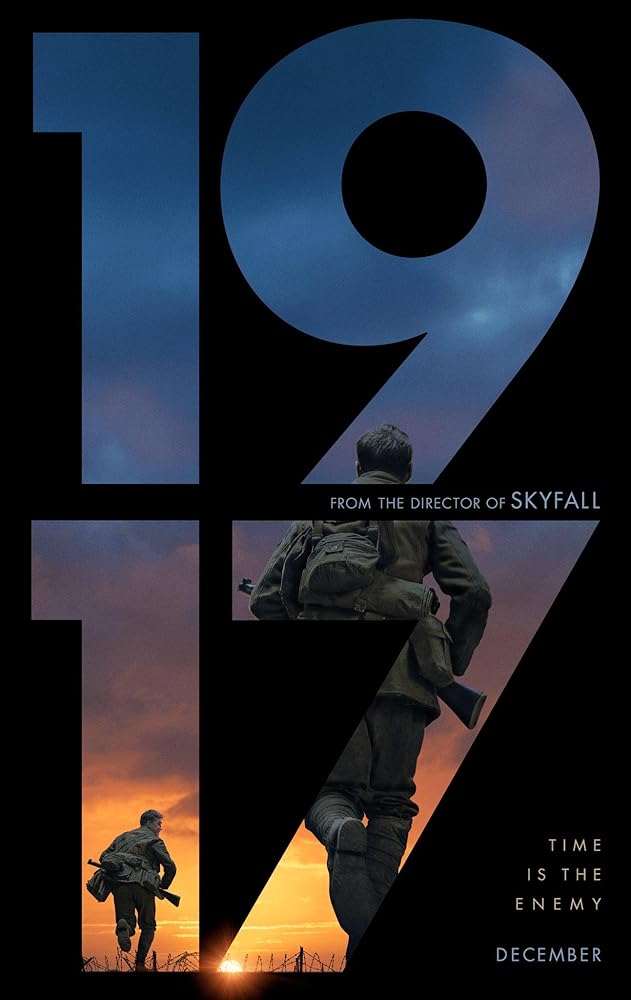
“1917” is directed by Sam Mendes (Spectre, American Beauty) and stars George MacKay (The Boys Are Back, Captain Fantastic), Dean-Charles Chapman (Into the Badlands, Game of Thrones), Mark Strong (Shazam!, Kingsman: The Secret Service), Andrew Scott (Fleabag, Sherlock), Richard Madden (Game of Thrones, Bodyguard), Claire Duburcq, Colin Firth (Love, Actually, Mamma Mia!), and Benedict Cumberbatch (Doctor Strange, Star Trek: Into Darkness). This film takes place throughout, as the title suggests, 1917. Specifically, during events of World War I. The story follows two British soldiers, Schofield and Blake, as they are given a mission to deliver a message to the 2nd Battalion of the Devonshire Regiment to call off an attack on the Germans. If this mission fails, this would mean there would be a loss of 1600 men, including Blake’s brother.

First off, let me just say to all of you that this is my first review of 2020, and what a better way to start off the year than to talk about movie that is literally a year. This film came out Christmas Day in select theaters, but much to my dismay, not one theater in the Boston area was going to show the film until 2020, so I had no chance to see it until then. This year is also the earliest time in which I was able to catch an advanced screening of the film. So I trekked to the theater this past Tuesday with high expectations.

When I say high expectations, I mean that literally. Knowing some of the technical aspects of the film, which I will dive into later on, it makes me giddy just thinking about it. Plus, this week was also the airing of the 77th Golden Globes, where this movie was nominated for 3 awards, and ended up taking home 2, including Best Picture – Drama. Granted, the more I think about the Golden Globes as a whole, the less meaningful I find them to be (after all, their voting board is not that big and they have genre-specific categories), but to have some notable recognition definitely helps. But in life, I live by the philosophy to form my own opinions on any matter at all times. Because life is just better when I’m in control. So what are my thoughts on “1917?”

mv5bmjfmyjnmnmetytuzmc00mwi2lwflzmutzmm3ywjiy2e2ngqyxkeyxkfqcgdeqxvynjg3mdmxnzu40._v1_sx1777_cr001777739_al_

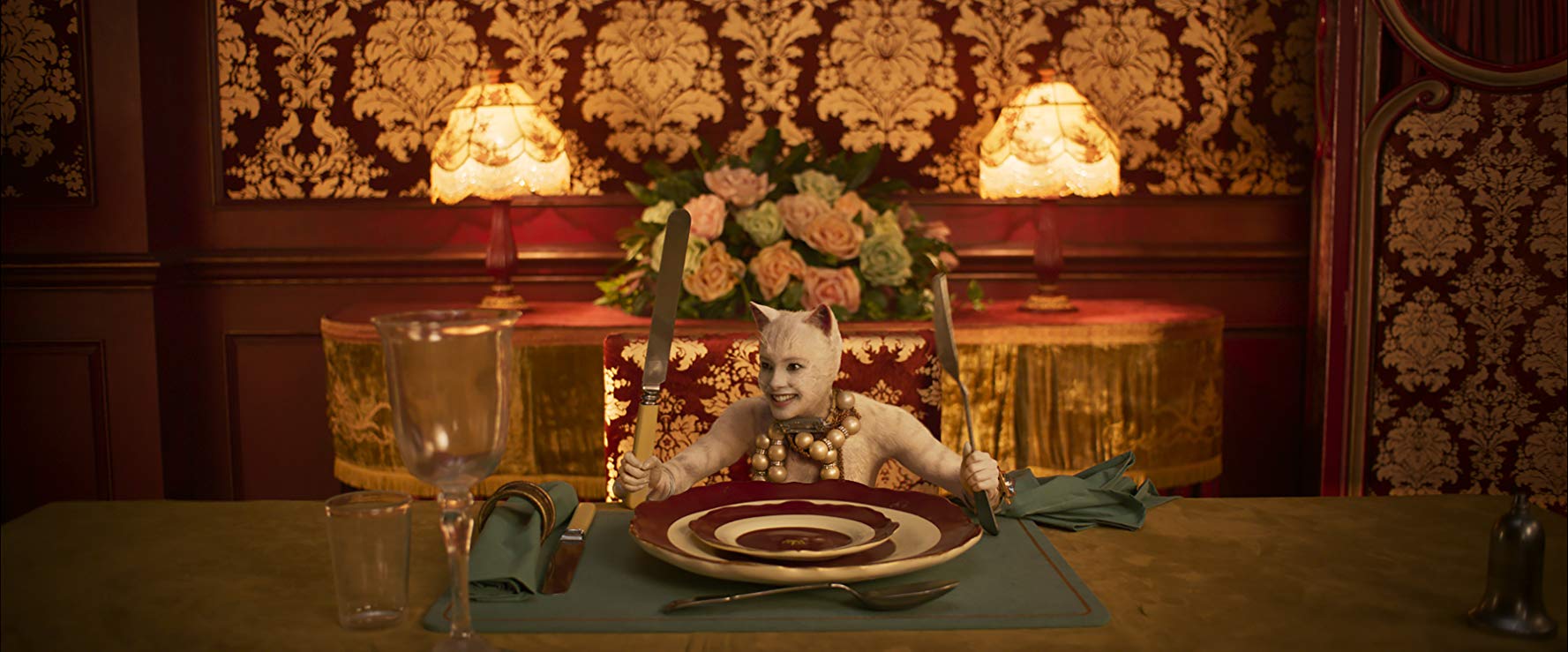
Let’s see… Oh! It’s better than “Cats!” But that doesn’t say much, now does it?

Let me try this again by asking you a question, because it sort of relates to my experience. How often has this happened to you? You go see a movie, and maybe you feel that what you just saw was wicked intense, and said intensity hits you to the point where your body just shuts down at a point. For me, that’s what “1917” felt like. I walked out of this movie nearly unable to feel my own legs. To help explain some of my thoughts on this film, I am going to remind you of another recent war film, specifically Christopher Nolan’s “Dunkirk.”

While “Dunkirk” and “1917” have their differences, one thing I cannot deny is that they both stand out in terms of how effectively they convinced me that I could have been in danger. I will say, “Dunkirk” had a slight undeniable advantage during my first viewing because I did see it in IMAX and I saw “1917” on a standard cinema screen, but regardless, “Dunkirk” emphasizes on sound more than “1917” does, which believe it or not, isn’t exactly a sign of this film lacking proper sound whatsoever. In fact, the sound editing and mixing in “1917” is great. I have no problems with any of that. But while “Dunkirk” emphasizes sound, “1917” emphasizes sight. Again, I’ll state that “Dunkirk” did a good job on that side of things as well. In fact, the movie received a Best Cinematography nomination, which it deserves. The way it utilizes 70mm and IMAX technology is undoubtedly impressive.

When it comes to “1917,” the technology used for this film, specifically the camera, is smaller. In fact, it runs on digital. The entire movie is shot using an Arri ALEXA Mini LF, which, if you don’t know much about cameras, the Arri ALEXA in general is often regarded as a current industry standard in filmmaking. This does make sense given what the crew behind this movie set out to do, which is film the movie with long takes, involving lots of movement. It’s not like this is one of those movies where the camera always sits still on a tripod, pretty much the entire movie tries to put you into the frame and take you along for the ride, and I’d say this was a pretty successful task. Because pretty much the entire time, even though I barely knew the two main characters, I was rooting for them to get out of whatever dire situation they were in. The long takes made me feel like I was transported in the movie, it made me feel like I was going to get shot, maybe debris would be flying onto my head.

The stellar cinematography in this film, which in fact, is without any argument whatsoever to be the best cinematography of 2019, is done by Roger Deakins, who also took on the job for iconic films including “The Shawshank Redemption” and “No Country For Old Men.” He also did one of my favorite films of the past few years, “Blade Runner 2049,” which he won his first Oscar for. There are several shots in this film that I can imagine myself wanting to hang in my living room if I had enough money for a big house and if I can find a good 5 panel canvas. And what really shocks me is a particular technique that is utilized during the film. I mentioned that the film is designed to look like it is one shot. Let me just tell you right now, it’s not. Without spoiling anything. There is a scene where the footage cuts to black, allowing for a slight break from whatever’s happening on screen. However, according to certain sources I have read, the film does cut but I didn’t even notice it on screen. According to the Hollywood Reporter, the longest shot in the movie is eight and a half minutes. This instantly brings a sense of hypnotization and eventually, a desire to look back at the film and try to guess when exactly the cuts happened. Plus, this film was shot on location, which brings a lot of challenges for the filmmaking process including an analysis on set design and the fact that lighting shots is perhaps an impossibility. And somehow, all of this was pulled off. This to me, cinematography-wise, may be in the top 10, maybe even top 5, all-time greatest achievements related to its category. I wouldn’t say it’s #1 at this point given how I still need time to marinate, but it does come close as of now, and if Roger Deakins DOES NOT win Best Cinematography this year at the Oscars, that award in all likelihood will be nothing short of a snub.

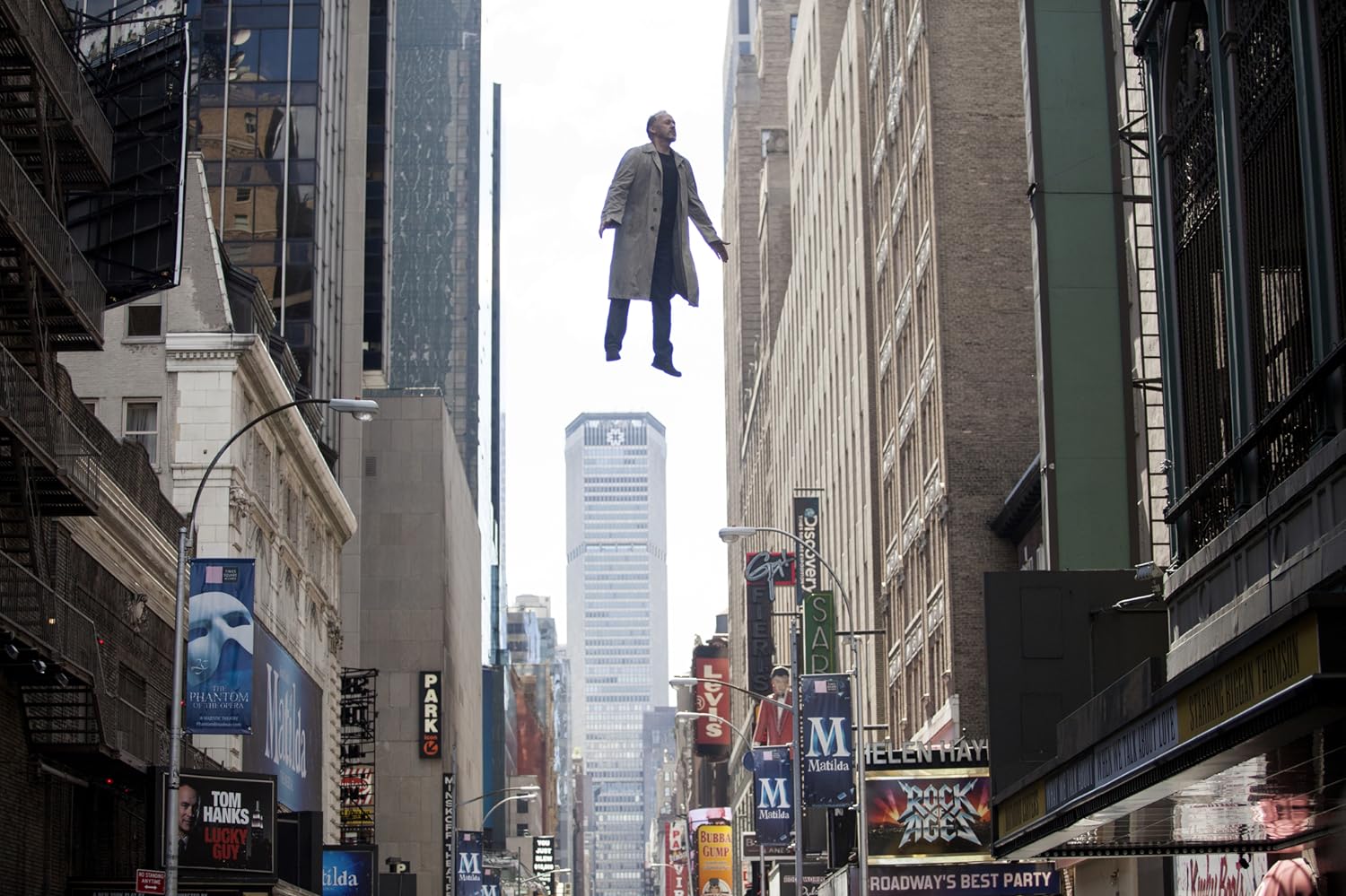
Another reason to consider how this movie is not #1 in terms of being the greatest cinematography achievement of all time is that this has been done before. Yes, this is sort of an upping of the stakes compared to Sam Mendes’ own long take shot experience from “Spectre,” a movie in which the cinematographer was Hoyte Van Hoytema, but that’s not the point. If you have followed 2014 in film, you may be familiar that the Academy’s Best Picture that year was “Birdman,” directed by Alejandro González Iñárritu (Babel, The Revenant). Having said that, I think the originality factor of that film helped me appreciate it. “1917” on the other hand is ultimately following in its footsteps. Story and concept-wise it stands on its own, but the intention when it comes to the visual aspects of the film is not completely different. Also, according to a quick Google search, the longest shot in “Birdman” goes on for fifteen minutes, compared to “1917,” which has a longest ongoing shot for eight and a half minutes.

In all seriousness though, this film, as a visual ride, is a tour de force, and I think this could be Roger Deakins’ best work just because of the daunting task at hand. And for that, I also have to give credit to Sam Mendes for helming this production. This is an experimental, ambitious film that I think will be looked back upon for years to come. In addition to all of the surroundings that make this film what it is, Thomas Newman’s score also does an effective job at adding something to the crazy experience on screen.

As for the characters, I wouldn’t say I didn’t care about them, but I am not gonna sit right here and tell you that they’re anything special. I did mention their names, but keep in mind that I glanced at them on Wikipedia as I write this review. In fact, I think the only name I recalled from the film is Colonel MacKenzie, maybe because I was paying enough attention. But at the same time, this movie is more about the journey, the effects throughout said journey, and this was one HELL of a journey. When I bring that up, part of me thinks that I almost don’t even need to know anybody’s name. In fact, I felt like *I* was a character experiencing this event alongside everyone else, therefore I am ultimately the one who should develop the most.

If I were a character in this movie, I’d say I’d start out curious, maybe a tad scared, but at the same time, I have to realize the consequences that can come from various actions. As the movie goes on, I would still be scared, perhaps even more so, but I would still tough out through whatever lies ahead. Eventually, I’d still be my terrified self, but I’ll have a feeling that I finally get to breathe. Seriously, whenever there is a moment of silence or calmness, it felt rewarding. I felt like I went through war with these characters simply because the camera’s eyes were almost like my eyes. Granted, it focuses a lot on these folks’ faces and I would probably never spend 2 hours almost continuously running backwards, but I think y’all get the point.

The film’s concept is simple, but it is also effective. Before I dive into the paragraph where I give my official rating, let me just say that this film, story-wise, is one I need to continue to think about. However, when it comes to various other aspects, it is one that I am pretty much set on. My rating could change, but anything is possible.

In the end, “1917” gave me pretty much everything I wanted. It is a beautifully shot, brilliantly directed, and solidly executed master work. It is just incredible to think about all the hard work and craftsmanship that went into this. There are a good number of war films out right now, but I’d say that this is 1,917 times as awesome as some others. I know some people who have seen a number of movies that will tell you that maybe whatever movie they saw at the theater is not worth the experience, maybe because there weren’t enough showman-esque elements in the movie or something. Let me tell you, and I’m not talking to everyone, because I understand that war films may not be everyone’s cup of tea, and that’s fine, but if you don’t go see this film in a theater, it’s a crime. A bad crime. Go see this movie on the biggest screen you can, with the best sound available. It’s out right now in Dolby Cinema, so if you’re willing to pay a higher ticket price, go there. Just see it! It’s an experience! As for the story, I mentioned that I have no problems with it, but it is one where I feel like I won’t remember anybody’s name. Maybe this is a movie to me that gets better the more I watch it. But we’ll just have to see. Also, the cinematography is PERFECTION. I’m going to give “1917” a 9/10. I wanted to give the film a 1917/10, but then I’d break the scale, so 9 it is.

Thanks for reading this review! I just want to remind everyone that this SATURDAY, JANUARY 11TH, will be the kickoff of my multi-part countdown event, “Top Movies of the 2010s!” I’m gathering all the entries, lining them up as we speak, and even though I am admittedly cramming at this point, I am hella excited to share my lists with y’all! If you want to see this and more content from Scene Before, give me a follow! If you have a proper account in place, feel free to leave a like and comment! Also, if you have a Facebook account, feel free to like my page to get notified about the latest goings on here at Scene Before through the place where you have friends, even those you probably haven’t talked to in five or so years. I want to know, did you see “1917?” What did you think about it? Or, what do you think is the better achievement in cinematography, this movie or “Birdman?” Let me know, you have one shot to impress me with your opinions! Scene Before is your click to the flicks!